Printed air fresheners are produced with two main techniques: offset printing and digital printing. Many suppliers do not say which one they use. For a buyer, the difference shows in colour accuracy, sharpness, price per piece and how consistent a reorder looks. BUGO DUFT has printed air fresheners in offset since 2014; this guide explains why, and when digital printing is the better choice.
How offset printing works
In offset printing, each colour (cyan, magenta, yellow and black) is transferred from a printing plate via a rubber blanket onto the card. The plates are made once per design. After that, the press prints large sheets at high speed, each with many air fresheners side by side, which are later die-cut into shape.
How digital printing works
Digital printing works like a large professional printer: the image is sent straight from the file to the press, without plates. Every sheet can be different, and there is no set-up per design.
Comparison for air fresheners
Colour accuracy
Offset reproduces brand colours very consistently across thousands of pieces and across reorders. Digital printing has improved, but colours can vary slightly between runs and machines.
Sharpness of small details
Fine lines, small text and QR codes come out crisper in offset, which matters on a card only 7 cm wide.
Price per piece
Offset has a fixed set-up per design, but a very low cost per extra piece. That is why prices fall sharply with quantity: at BUGO DUFT from €179 for 250 pieces to €0.249 each at 1,000 and €0.189 each at 100,000. Digital printing has almost no set-up but a higher, flat cost per piece.
Personalisation
Digital printing wins when every piece needs a different name or code. Offset prints the same design on every piece of a run.
Which technique fits which order?
- **Under 100 pieces, individual names or photos:** digital printing.
- **From 250 pieces, one or two designs, brand colours that must match:** offset printing.
- **Reorders of the same design:** offset, because colours stay consistent with earlier runs.
What offset means for your artwork
- Send vector files (PDF, SVG, AI, EPS) where possible; they give the sharpest result.
- Name your brand colours in CMYK or Pantone if they must be exact.
- Keep text at least 7 pt and lines at least 0.3 mm thick.
- Our proof shows the design as it will be printed; approve colours there.
Both sides in full colour
Offset prints the front and back in full colour. With BUGO DUFT the back can carry completely different artwork, such as a QR code or contact details, at no extra cost.
From print to finished air freshener
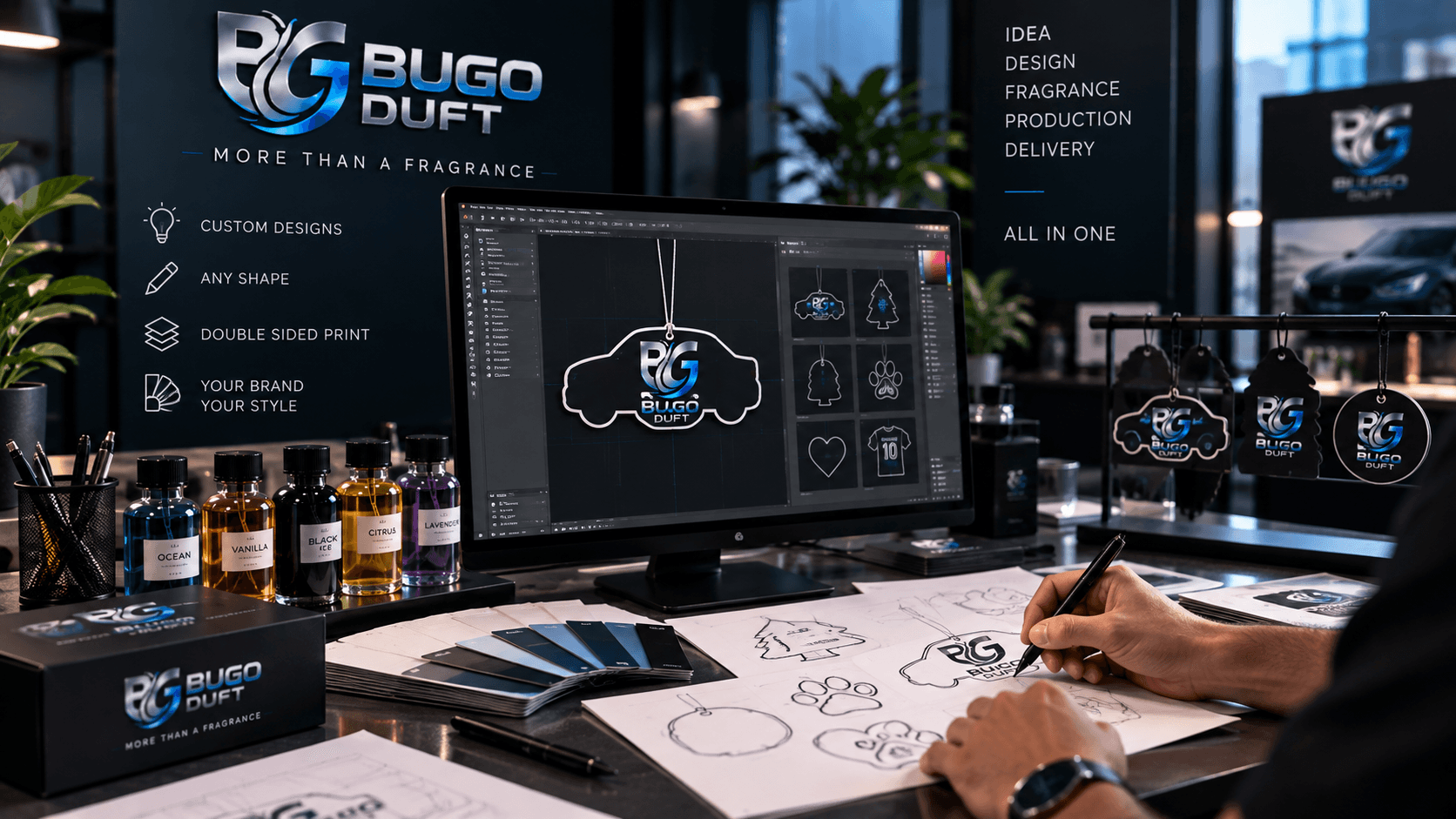
After printing, the sheets are die-cut to your shape, scented with the chosen fragrance, packed individually in airtight film and quality-checked. With a capacity of three to four million pieces a month, regular orders are produced within 10–12 working days after approval.
Frequently asked questions
Is offset printing more environmentally friendly?
For larger quantities, offset typically produces less waste per piece because the set-up is shared across the whole run. For very small runs, digital avoids plate production.
Will a reorder look exactly the same?
Using the same approved artwork and colour values, offset reorders are very close to the original run, which is important for brands with strict colour guidelines.