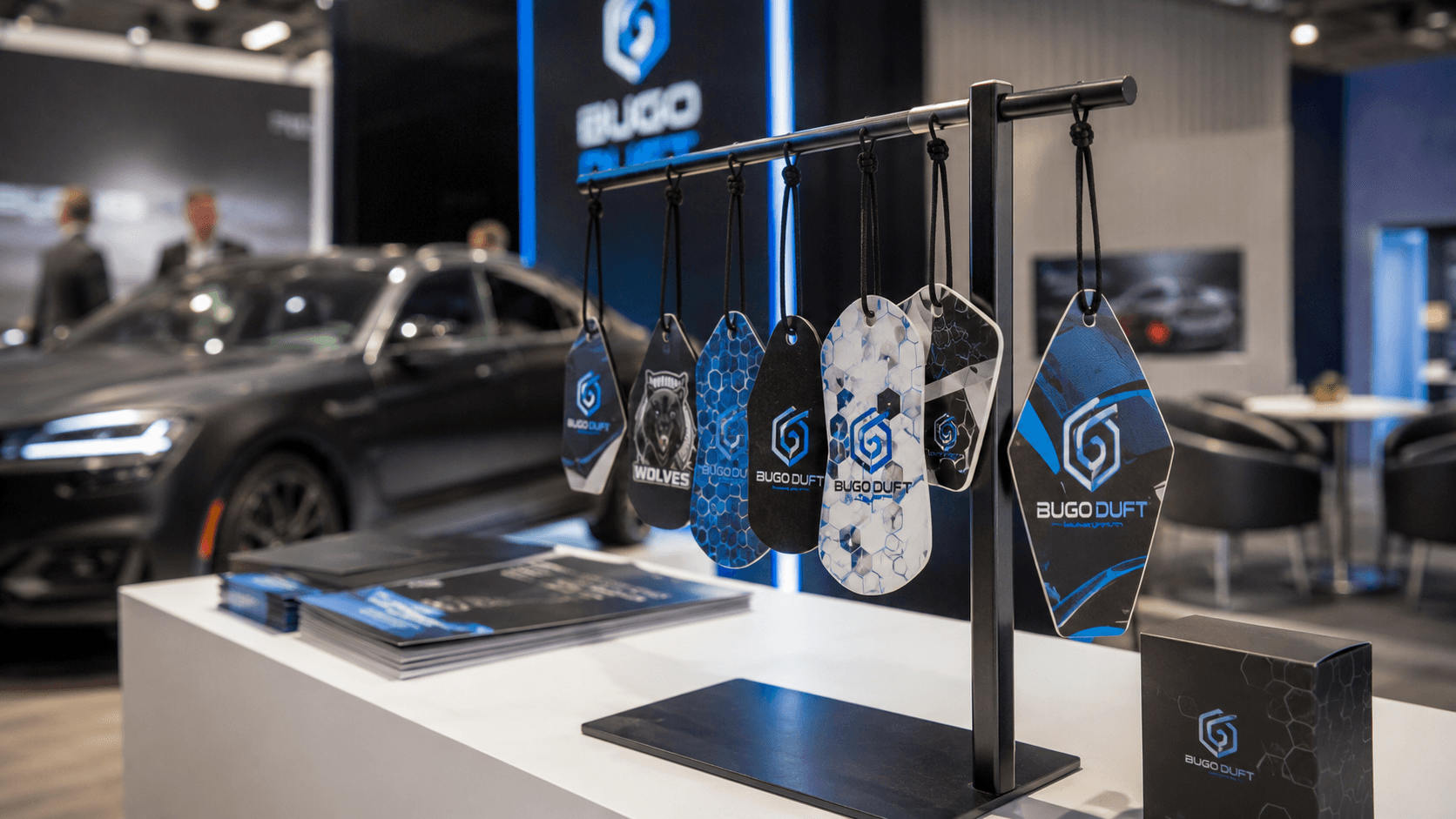
Every marketing budget has to answer the same question: which promotional product will people actually use, where will they see the logo, and what does each contact cost? Air fresheners are not the right answer for every business, but for anyone whose customers drive, they compare remarkably well. Here is an honest comparison with the most common giveaways.
The comparison criteria
We look at five things that decide whether a giveaway works:
- **Visibility:** how often does the recipient see the logo?
- **Location:** is the product used privately or seen by others too?
- **Lifetime:** how long does it stay in use?
- **Unit cost:** what does one piece cost at typical quantities?
- **Fit:** does the product relate to what your business does?
Pens
Cheap and universal, but pens travel: they end up in other people's bags and drawers, and the logo is small. Good for hotels, conferences and banks where a pen is needed on the spot. Visibility per day is low.
Mugs
A mug on an office desk is seen daily, by the owner and colleagues. Unit costs are much higher than for paper products, and shipping heavy, fragile items adds to the cost. A good choice for key B2B accounts, less so for mass hand-outs.
Tote bags
Very visible in public when used, with a large print area. Many people already own several and use only one or two, so the rest are rarely seen. Works best at fairs where visitors need to carry material.
Calendars
Seen daily for a year, but only in one place and only if the design is good enough to hang. Timing is tight: calendars are handed out in December and January only.
Printed air fresheners
- **Visibility:** at eye level in the car, every journey, also seen by passengers.
- **Lifetime:** the fragrance is noticeable for about a week; the card often stays on the mirror much longer.
- **Unit cost:** from €0.249 each at 1,000 pieces, including design, shipping and customs. 250 pieces cost €179 in total.
- **Fit:** natural for car dealers, garages, car washes, driving schools, rental companies, taxis and any business that hands over keys or vehicles.
- **Weakness:** less relevant for audiences who do not drive, and the fragrance is temporary, so the moment of hand-over matters.
Cost per contact: a simple calculation
Take 1,000 air fresheners at €249. If each hangs in a car for one month and the driver sees it twice a day, that is about 60 contacts per piece and 60,000 contacts in total: around €0.004 per contact. Change the assumptions to your own customers; even at a quarter of that figure, few printed products come close.
Which giveaway for which business?
- **Automotive businesses:** air fresheners, because the product fits the moment of hand-over.
- **Offices and B2B accounts:** mugs or calendars for a few key contacts, air fresheners for wider distribution among drivers.
- **Events and fairs:** air fresheners or tote bags, depending on whether visitors travel by car.
- **Hospitality:** pens on site, air fresheners for valet and shuttle guests.
Combining products
Many businesses combine a small number of premium gifts for key clients with a high-volume giveaway for everyone else. Air fresheners are a strong choice for the high-volume part: light, cheap to ship and easy to hand out.
How to make an air freshener feel like a quality gift
- a custom shape that reflects your brand
- a clean design with a large, high-contrast logo
- a pleasant, broadly accepted fragrance
- optional header card packaging for premium presentation
Why air fresheners work as car giveaways